
“In a way Detroit is the birthplace of this civilization. It is truly a world capital as any city on earth, more fascinating to the outlander than New York, more influential than Washington, or even Hollywood. Paris dictates a season’s silhouette, but Detroit manufactures a pattern of life” (Binelli 2012, p. 28). That is a quote from New York Times columnist Anne O’Hare McCormick in the year of our lord (figure of speech) nineteen hundred and thirty-four. That was ninety years ago…

It’s safe to say that Detroit was a happening place. Jobs were plentiful due to a booming auto industry, houses were cheap for the working man, and jazz and blues were flowing through the streets. And, our friend Anne–the New York Times columnist–was not the only one to share that opinion, Detroit’s greatness was commonly known. Binelli describes Detroit as “the greatest working-class city in the most prosperous country in the world”, and “the Silicon Valley of the Jazz Age” (Binelli 2012, p. 3). Keep some of those quotes in mind.
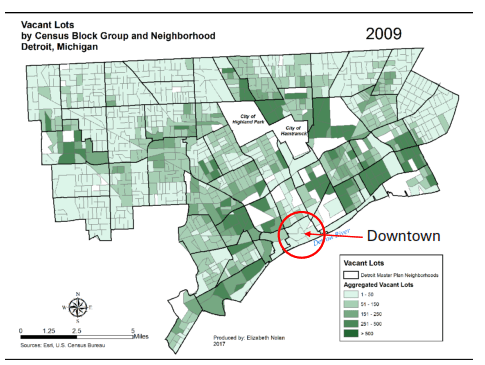
Look, there’s no need to revisit why Detroit fell from glory—the loss of the auto industry, the 1967 riot, and other factors have been well-documented. Let’s get back to the point. Did you know that as of 2012, the entirety of Paris could fit within Detroit’s vacant land—forty square miles? (Binelli 2012) And New York? Manhattan would nearly fit into that space twice over! And all that vacant land hasn’t just gone away in 12 years…

Let’s be clear, this isn’t an anti-Detroit post. I love Detroit and its people–legacy residents and new. Like many stubborn (Caucasian?) Americans, I have a deep yearning for the frontier–we don’t need to unpack that here… And let me tell you, modern Detroit still feels very much like the frontier.
Now to the meat of this post. Have ya’ll heard about the Detroit Renaissance? Pretty cool, huh!? Look if your attention span is too short, I also broke this down on TikTok… The point is, Detroit’s back, baby! Or so they say.

Wait… I’ve seen this before. The Residences Water Square… Didn’t South Park do this bit? Rich people move in and now we all get nice things?

Look, revitalization efforts like these bring both opportunities and challenges. While Downtown has seen major investment, plenty of questions remain about who really benefits.
Wait, wait—we’re not cancelling the Renaissance. It’s still on! And it’s very cool that you can get lost in Detroit’s Downtown some nights and almost feel like you’re in Manhattan. Okay, maybe not quite Manhattan, but it’s not such a crazy comparison! But check out this map—even as we celebrate Downtown’s resurgence, it’s still just a tiny part of Detroit’s vast landscape.
Alright, alright, I know it’s not just Downtown—which Detroiters can largely thank Dan Gilbert for. Sidebar, Mr. Gilbert brought in Quicken Loans along with 17,000 jobs and $5.6 billion in investment (Mallach 2023).
Looking beyond Downtown, I know TechTown isn’t quite the Silicon Valley of the iPhone age, but it’s a happening area with strong technology businesses. Corktown is a revitalized historic neighborhood, right next to Downtown. Indian Village still had a few abandoned houses last I checked, but that place is luxury. Ditto to the other historic in-city historic suburbs of Palmer Woods and Sherwood Forest. One thing all these areas have in common (well, outside of TechTown)? They’re all unique, historic and beautiful.


And let’s not forget, there’s plenty of good stuff outside the city proper. But that doesn’t change the fact that a large portion of Detroit feels almost agrarian. Does everyone get my Grosse Pointe here?
The main point being, you can’t take what was once debatably the greatest city on earth, spruce up Downtown and a few core neighborhoods, and call it a renaissance. Yes, yes, property values are rising across Detroit. But has that translated into a population boom—or just a reshuffling of who gets to live where?
In 1950, Detroit was the 5th largest city in America (see below), home to 1.85 million people. By 2020, it had fallen to #26, with just 639,000 residents. That’s a loss of nearly two-thirds of its population. And the Renaissance? For the first time in 70 years, Detroit saw a net gain in residents—1,852 people. A drop in the bucket. And we can safely assume most of that net increase went to Downtown Detroit and surrounding areas. So what about the periphery? What about all that vacant land?

And that’s where things get interesting. Let’s be real—Detroit isn’t returning to its peak of 1.85 million residents, and those neighborhoods will almost certainly never be as dense as they once were. So, what are communities doing with ALL THAT LAND? Well, they’ve been finding creative solutions for years. Did I mention Detroit’s agrarian feel? The city is now home to 2,200 urban farms and gardens which are engaging nearly 20,000 Detroiters (Misuraca Ignaczak 2024).
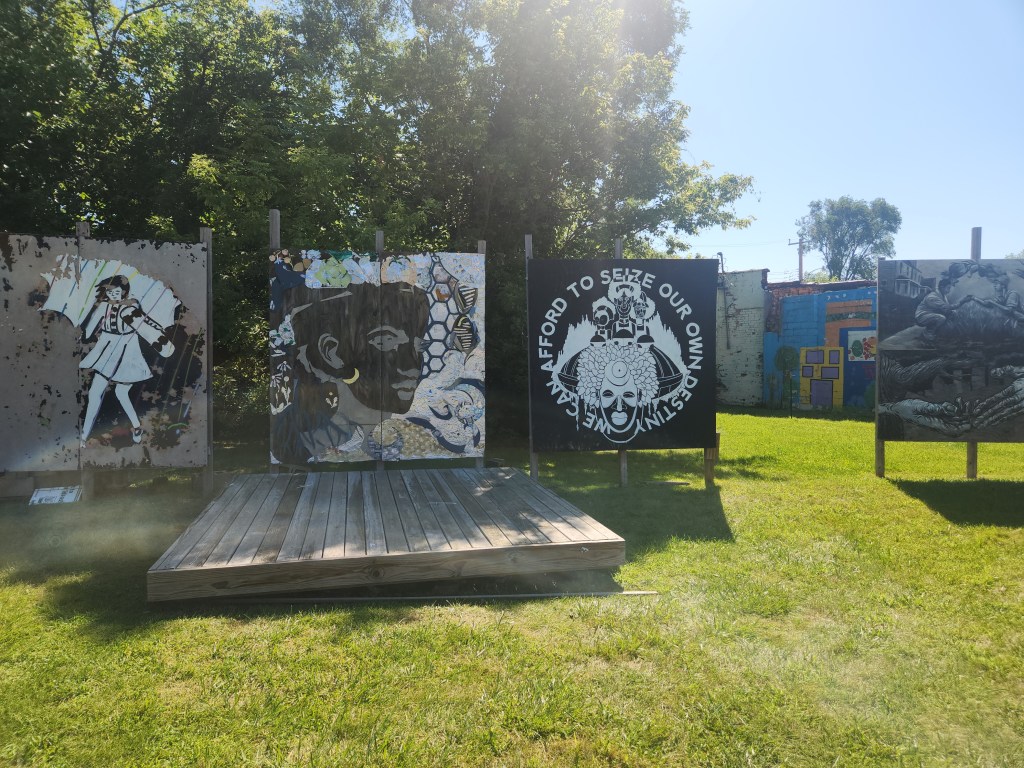
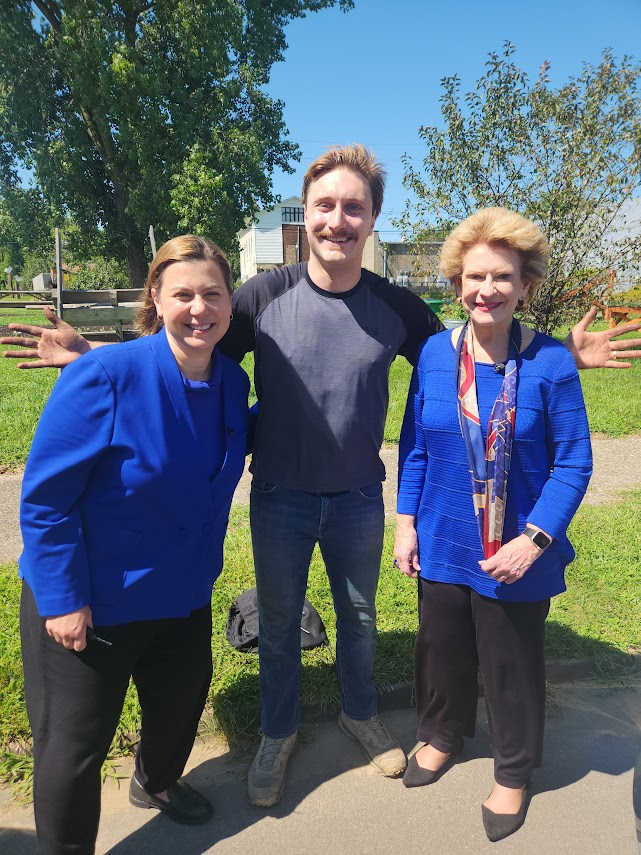
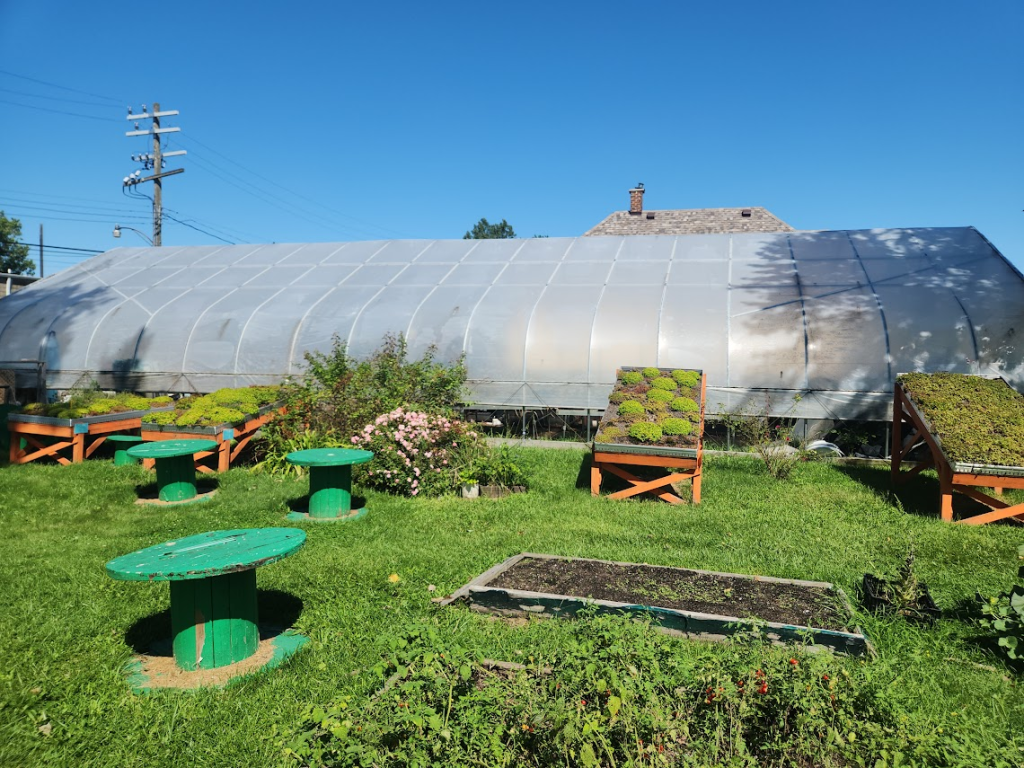
Amidst this remarkable urban agriculture movement, Oakland Avenue Urban Farm (OAUF) stood out as a place doing something truly different–which is why I chose to highlight it in my recently completed Master’s paper. And, apparently, I’m not the only one who thinks so—U.S. Senator Stabenow and now Senator-elect Slotkin just happened to roll through while I was picking beans—always offer to volunteer. And John Legend? Just missed him.
OAUF supports a variety of incredible programs, like the Northend Co-Op Academy, which helps residents create cooperative businesses, and the Black Farmers Land Fund, which provides aspiring Black farmers with access to land (“Oakland” n.d.). And that’s just a tiny sample. During the height of the pandemic, they partnered with others to serve over 25,000 meals to their community, even delivering food directly to the doors of vulnerable residents. Basically, they’re the real effing deal!
To summarize: Detroit gained 1,852 residents last year. Slow clap. But was Detroit’s greatness ever really about the raw numbers? Detroit used to build things—big hunks of metal that shepherded millions of people around this great nation. Today, the circumstances are different, and Detroiters are called upon to build something else: green spaces, strong communities, and a sustainable future.
Out of all of America’s postindustrial cities, Detroit climbed the highest and fell the furthest. And now, it demands the most substantial and innovative solutions.
Unlike top-down efforts focused on high-end development, urban greening empowers legacy residents to lead the way in reimagining Detroit’s future. Senator-elect Slotkin knows it. John Legend knows it. And now, you know it. Urban greening isn’t just a movement—it’s a way forward. So, is Detroit once again manufacturing a pattern of life? I’d say that’s the real Renaissance.
I hope you enjoyed this blog post, please subscribe below and thanks for reading!
References
- Binelli, M. (2012). Detroit city is the place to be: The afterlife of an American metropolis. Picador.
- Mallach, A. (2023). Smaller Cities in a Shrinking World: Learning to Thrive Without Growth. Island Press.
- Misuraca Ignaczak, N. (2024). Composting, water access and backyard chickens: Detroit’s urban farming evolution. Planet Detroit. https://planetdetroit.org/2024/03/detroit-urban-farming-tepfirah-rushdan/#:~:text=Detroit’s%20urban%20agriculture%20movement%20began,Network%20and%20Keep%20Growing%20Detroit
- Oakland Avenue Urban Farm. (n.d.). https://www.oaklandurbanfarm.org/
Images
- https://admin.onlyinyourstate.com/wp-content/uploads/sites/2/2022/04/Michigan__Griswold_circa_1920.jpg?w=500&quality=50
- https://www.freep.com/gcdn/authoring/authoring-images/2024/02/06/PDTF/72496637007-water-square-020624-es-09.jpg?width=1320&height=882&fit=crop&format=pjpg&auto=webp
- https://static.wikia.nocookie.net/southpark/images/4/4e/SoDoSoPaLoftsResidences2.png/revision/latest/scale-to-width-down/1000?cb=20210412161050
- https://pbs.twimg.com/media/Fhu_jeBVQAAvD2F.png


Leave a comment